Why Booking.com is no longer enough as your only booking channel
We recently spoke with an owner of two apartments in Dalmatia. Season fully booked, guests happy, reviews excellent.
Then she said one sentence that turned the conversation serious:
"If Booking changes the algorithm tomorrow — I'm done."
And she was right.
That's the situation most holiday rental owners in Croatia are in today — from apartments and holiday homes to guest houses, rooms and smaller boutique properties. The business runs. The season is full. But the whole structure stands on one leg — and that leg isn't theirs.
Booking isn't the enemy. It was, and still is, the easiest way to fill a property. But something is shifting, on several parallel lines at once.
Search is changing — and it's already happening
Before we even talk about commissions and margins, you have to understand the bigger change happening above all of this.
Guests no longer start their search only on Booking.
More and more they first ask ChatGPT, Gemini or Perplexity:
"Recommend me a place to stay for 6 near Split, quiet location, arrival in August."
AI answers. It names concrete properties. The guest then goes to verify reviews and photos — and only then, maybe, ends up on Booking to hit "reserve".
If AI didn't mention you in that first conversation — the guest never even saw you. Regardless of whether you might be in the top ten on Booking.
Why depending on one channel is a business risk
In every business the same rule applies:
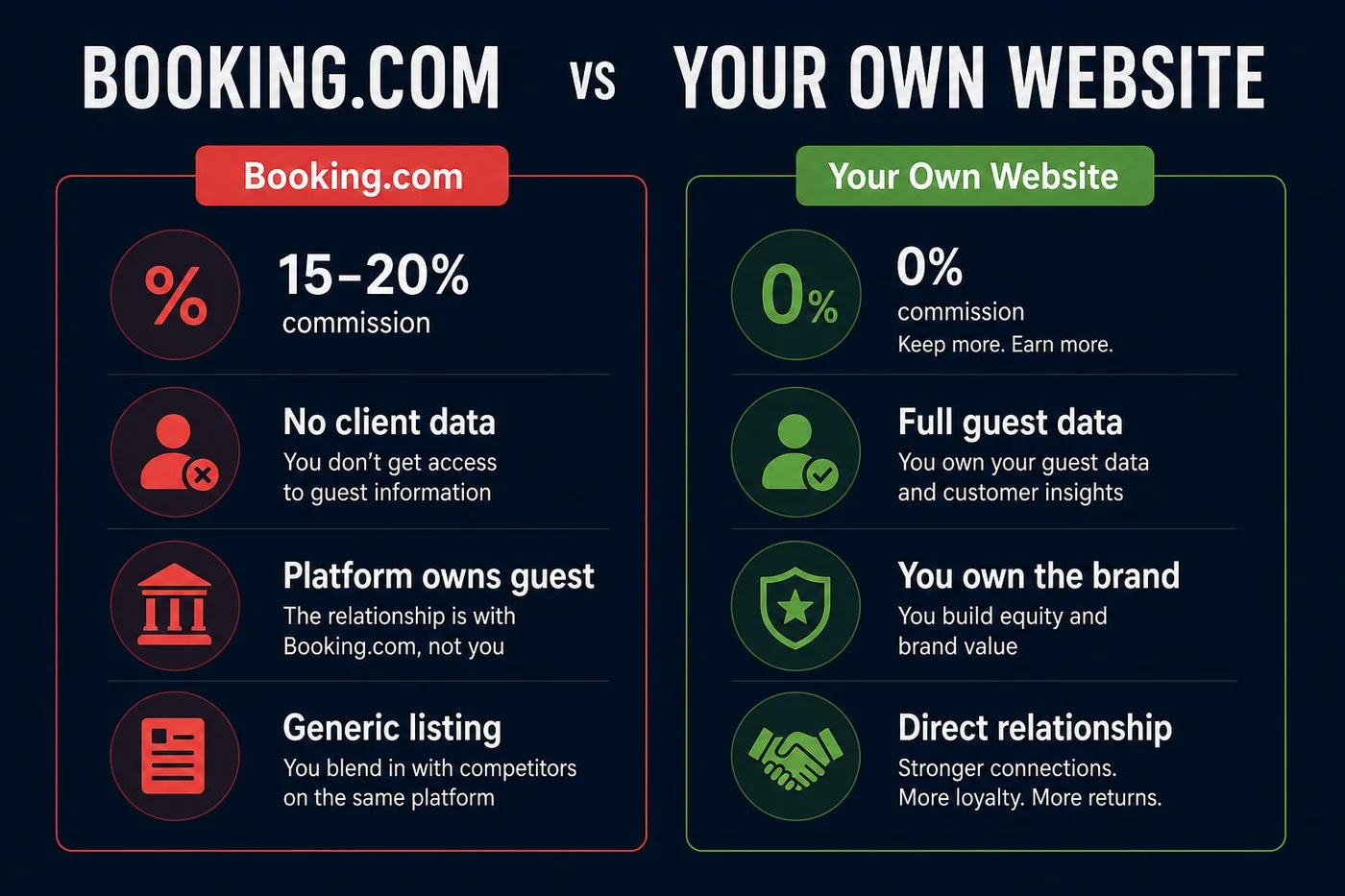
An accommodation owner with 100% of bookings from Booking isn't really a business owner — they're Booking's partner. A junior one. When the platform changes the algorithm, the owner feels it instantly. When it raises commission, there's nothing they can do. When it introduces a new "preferred partner program" — pay, or disappear from the first screen.
It's not a catastrophe. But it is a risk that grows every year.
And this is where, slowly, your own website enters — but in an entirely new role.
A website is no longer a "brochure" — it's become a second channel
Five years ago a site was an aesthetic thing. Nice to show, not very useful.
Today it has two concrete functions.
The first is trust. A guest who heard about you through AI, a recommendation or Booking comes to verify you. If they find a serious, fast, clear website — they're inclined to book directly. Without 15% commission.
The second is AI visibility. Your site is the source AI learns from. Booking is the storefront. Your site is the dossier. Without that dossier, AI struggles to tell you apart from any other apartment, house or room on the coast.
Three examples from practice
Boutique accommodation in Dubrovnik — the owner got guests only via Booking. We built a site with a clear story and direct inquiry forms. In one season 30% of guests booked directly.
Holiday home in Istria — a family who wanted returning guests, not new ones every week. Their own site and mailing list got them a 40% return rate.
Apartments in Dalmatia — the owner runs five units. Direct bookings now bring her more profit than the first twelve on Booking.
Why at Webvula we focus on this
We've seen the same conversation too many times to ignore it.
An owner with a great property and a full season — but with no control over where guests come from. No emails of those guests. No way to message them next year. No plan B if the algorithm shifts.
At Webvula we've spent the last year working primarily with owners of apartments, holiday homes, guest houses and villas — though not exclusively. We build sites that have two obligations: convince the guest to book directly, and give AI search engines information in a format they understand.
It's not a big investment. A professional site for tourist accommodation with us starts from €400.
What a direct channel actually brings
This isn't about leaving Booking. The point is to stop depending only on it.
Owners who successfully build a direct channel — usually 25 to 40% of bookings within a season or two — share the same things: they have their own fast, modern site, they appear in Google and AI search, and they build their own base of returning guests.
The difference between "I use Booking" and "I depend on Booking" is the difference between a business that grows and a business that survives.
A question worth asking
If Booking changes something tomorrow — algorithm, commission, rules — how would it affect your season?
If that scenario makes you nervous, you're not alone. That's the situation of most owners today.
But it's not a reason to panic. It's a reason for a second channel.
The good news
Most owners know they should do something, but haven't yet. The market isn't saturated. Direct bookings and AI visibility are still open opportunity — not a competition against thousands of others.
Those who move first — will probably have the calmest next few seasons.
Thinking about a second channel?
Send us a message and we'll look together at whether it makes sense for your property. The first consultation is completely free and no-obligation.